
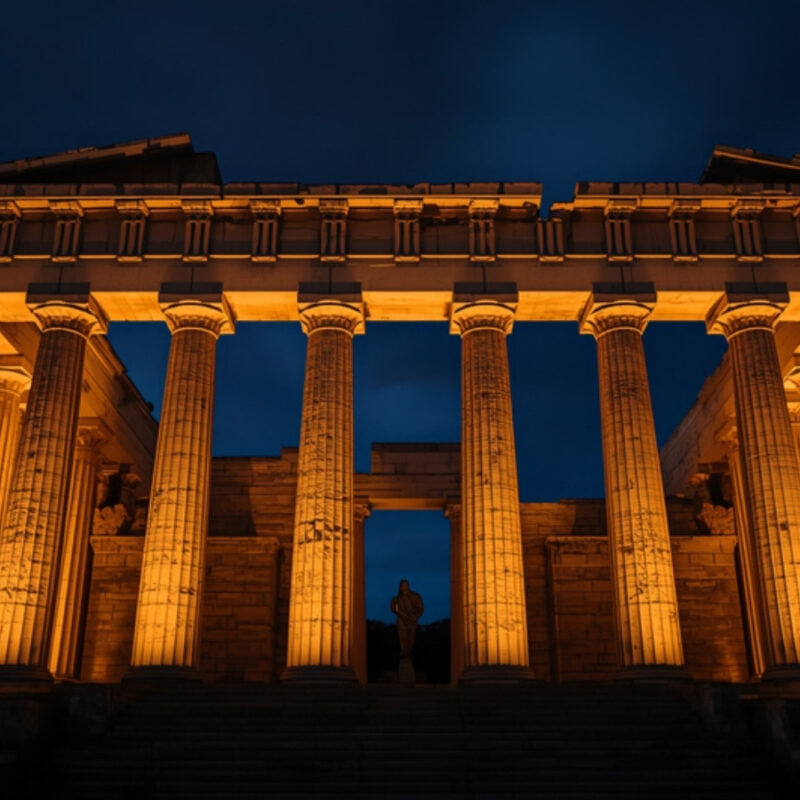
There are very few places in the world where an audience settles into their seats with a Roman temple complex lit up behind the stage, but that has been the defining image of Lebanon’s Baalbeck International Festival for decades. Held each summer among the colossal columns of the Temple of Jupiter and the Temple of Bacchus in the Bekaa Valley, the festival has survived civil war, regional conflict and repeated interruptions to remain one of the Arab world’s longest-running performing arts events.
The setting does a lot of the festival’s work for it. Few concert productions anywhere can offer a backdrop with two thousand years of history behind it, and performers across genres — classical orchestras, opera singers, jazz musicians, and major names from the Arabic song tradition — have spoken over the years about how the site changes the register of a performance. Sound carries differently among the ruins, and the scale of the columns tends to pull a show toward the ceremonial, whatever genre is on stage that night.
That mix of programming has always been part of Baalbeck’s identity. Rather than anchoring itself to a single genre or scene, the festival has historically moved between Western classical repertoire, regional orchestral works, and major Arabic vocal performances, often within the same season. It’s less a festival built around one audience’s taste than an attempt to use an extraordinary site to host whatever the organizers judge worthy of it in a given year.
Lebanon’s broader instability over the past several years has made each edition feel less guaranteed than it once might have. Currency collapse, political paralysis, and repeated security concerns have all, at different points, threatened to derail planning, and the festival’s continued survival has taken on a symbolic weight beyond its programming. For many in Lebanon’s cultural sector, keeping Baalbeck running each summer has become its own quiet statement — proof that the country’s arts infrastructure can still function even when much else can’t.
None of that diminishes what the festival offers on its own terms. For visitors and Lebanese audiences alike, an evening at Baalbeck remains one of the more distinctive live-music experiences available anywhere in the region, built on a combination of acoustics, history and setting that no purpose-built venue could easily replicate. Whatever challenges the country faces beyond the festival grounds, the temples are still standing, and so, for now, is the festival built around them.