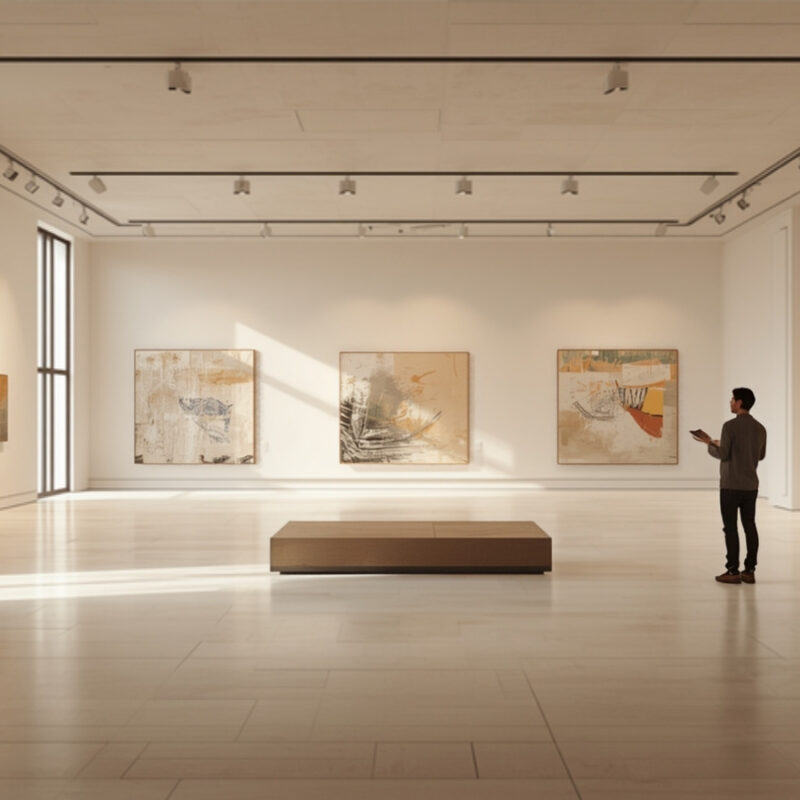
Art Dubai’s 20th edition, running May 14 to 17 at Madinat Jumeirah, arrives at a point where the fair’s own history has become part of the story. Launched in the mid-2000s when the Gulf’s contemporary art infrastructure was still largely theoretical, Art Dubai has effectively grown up alongside the region’s museums, galleries and collector base, and this year’s programming reads partly as a victory lap and partly as a snapshot of where that ecosystem stands now.
Among this year’s participants, the range says as much as any individual booth. Jeddah’s Athr Gallery, a presence in the Saudi scene since 2009, returns with the kind of experimental program that helped define Saudi Arabia’s contemporary art identity before the Kingdom’s recent wave of cultural investment made that identity a matter of state policy. Ramallah’s Gallery One, by contrast, brings a program explicitly framed around tracing a Palestinian artistic lineage rooted in Cairo’s academic painting tradition — a reminder that gallery programming in the region often carries historical and political weight that a casual fair-goer might walk past without registering.
Dubai’s own Meem Gallery anchors part of this year’s presentation around a solo exhibition of Dia Al-Azzawi, one of the most significant living Iraqi artists, whose six-decade career bridges mid-century Baghdad modernism and the diasporic practice he’s built since leaving Iraq. A solo booth of this scale, inside a fair rather than a museum survey, is itself a marker of how far gallery-level infrastructure in the Gulf has advanced — this kind of depth of presentation would have been difficult to support at the fair’s earlier editions.
International participation has grown more selective rather than simply larger. French gallery Frank Elbaz makes its Art Dubai debut this year with a materials-focused program featuring Sheila Hicks, Kenjiro Okazaki and Machiko Ogawa, while Genoa’s Pinksummer brings Tomas Saraceno’s atmospheric, science-adjacent installation work. Neither reads as an attempt to simply plant a flag in a growing market; both fit coherently into the fair’s broader curatorial identity, which has increasingly prioritized depth of program over sheer booth count.
Twenty years in, what’s most notable about Art Dubai isn’t how large it’s become, but how specific. A fair that once had to justify the existence of a serious contemporary art market in the Gulf at all can now afford to be selective about which galleries and which projects get stage time — a different kind of milestone than ticket numbers or sales figures, but arguably a more meaningful one for the health of the region’s art ecosystem going forward.