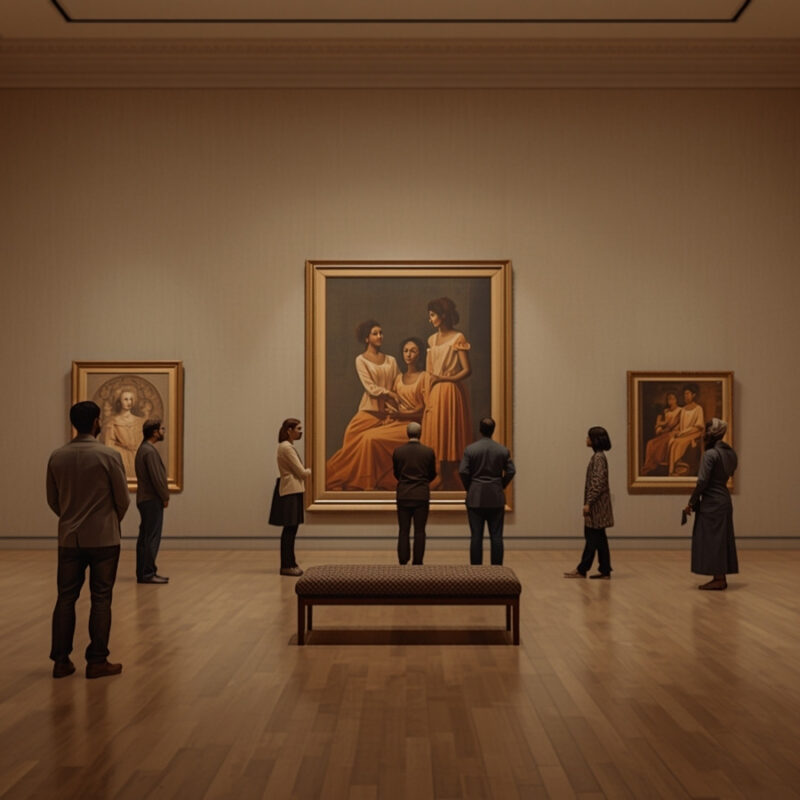
Holding an art fair inside the Grand Egyptian Museum complex is its own kind of statement, and Art Cairo’s seventh edition leaned into it fully. More than 40 galleries from Egypt, the broader Arab world and Europe took part under the theme ‘Arab. Art. Here.’ — a title blunt enough to read as a direct claim about where contemporary Arab art deserves to be seen, staged a few hundred meters from some of the oldest art objects in human history.
Walking the fair, it was hard to miss how firmly figurative painting still dominates what galleries choose to bring and what collectors choose to buy. Abstract work was present but limited; Iraqi artist Himat Ali’s ‘Stations of Love’ series, pairing reversed Adonis poetry with blossom-inspired abstract forms, stood out partly because it was one of the few booths prioritizing mood and ambiguity over legible subject matter.
The figurative work on display ranged widely in tone. Syrian-Iraqi artist Serwan Baran’s ‘Red Crescent’ series used blurred, almost smeared renderings of crowds and paramedics to depict conflict obliquely — recognizable as documentary subject matter without ever resolving into a clean, legible scene. At the opposite end of the emotional register, Majd Kurdieh’s saturated pastoral landscapes, dotted with butterfly motifs, offered exactly the kind of accessible, visually striking work that tends to do well with collectors buying for their homes rather than for conceptual weight.
That range points to something true about Art Cairo’s role in the region’s art calendar: it isn’t primarily a showcase for experimental or market-disrupting work, but a genuine commercial fair where mid-career and established artists meet buyers who want work they can live with, alongside institutional-grade pieces that make the trip worthwhile for serious collectors and curators. Last year’s edition reportedly generated over $1.2 million in sales, a figure that speaks to how functional the fair has become as a commercial engine rather than simply a cultural showcase.
The growing presence of European galleries — Utrecht’s Galerie Sanaa returned this year with Syrian-Dutch painter Raafat Ballan’s melancholic portraiture — suggests the fair’s reach is expanding outward even as its core identity stays rooted in Cairo and the wider Arab gallery scene. As one participating gallerist put it, fairs like this matter because galleries across the region often work in isolation, with limited budgets and few chances to compare notes with peers facing the same constraints elsewhere. Held this year beside the pyramids’ newest neighbor, Art Cairo made a reasonably convincing case that it’s becoming one of the more dependable of those chances.