
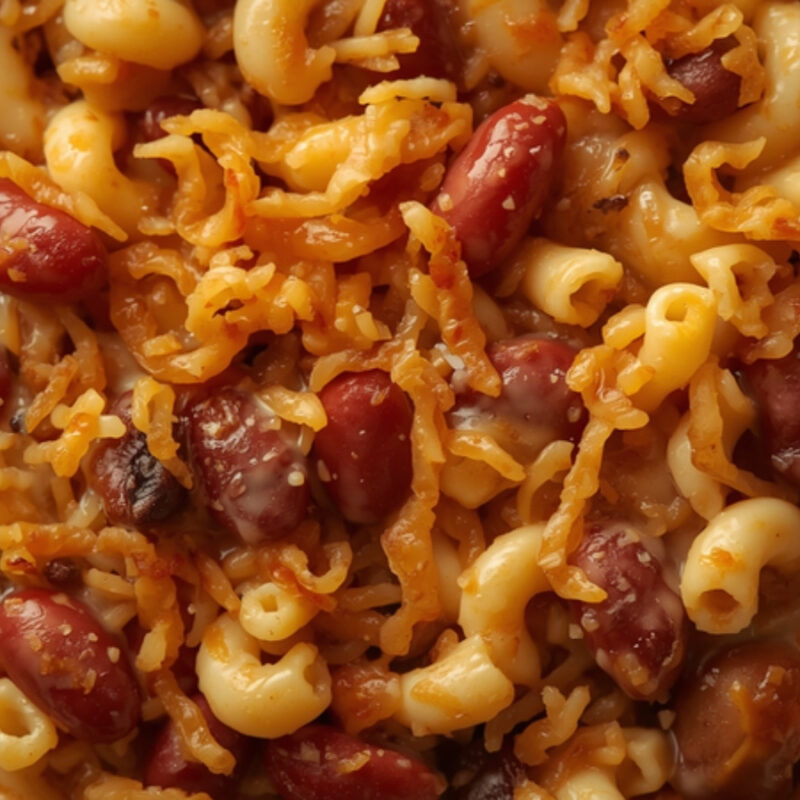
Most dishes that earn international cultural recognition tend to be elaborate — tied to feasts, ceremonies, or techniques requiring years of training to master. Koshary, Egypt’s layered combination of rice, lentils, macaroni and chickpeas, topped with a tomato-garlic-vinegar sauce and crispy fried onions, is almost defiantly the opposite: cheap, fast, found on nearly every street corner in the country, and precisely because of that ubiquity, it recently earned its own place on UNESCO’s Intangible Cultural Heritage list.
The dish’s exact origins are genuinely contested, which is itself part of its story. Food historians have traced elements of koshary to Indian, Italian and Egyptian culinary traditions converging in Cairo, likely shaped by waves of immigration and trade that passed through the city over the nineteenth and twentieth centuries. Rather than settling the debate, that layered, uncertain origin story has become part of how Egyptians talk about the dish — as something assembled from whatever arrived in Cairo and made genuinely Egyptian in the process, much like the dish itself layers several separate components into one bowl.
What the UNESCO recognition is really honoring, more than any single recipe, is koshary’s role as a social leveler. It’s sold from humble street carts and modest neighborhood shops as readily as from upscale restaurants that have begun putting elevated versions on their menus, and the price point has historically stayed low enough that it functions as one of the genuinely shared culinary experiences across Egypt’s sharp economic divides. A university student and a wealthy businessperson are, in a meaningful sense, more likely to have eaten the same koshary from the same kind of place than almost any other dish in the country’s culinary repertoire.
That accessibility has also made koshary a kind of informal ambassador for Egyptian food abroad, often serving as newcomers’ introduction to Egyptian cuisine specifically because it travels well and requires no particularly specialized ingredients to approximate outside the country. Egyptian diaspora communities have long used koshary nights as an easy, communal way of sharing a piece of home with friends unfamiliar with the cuisine, which has helped cement its reputation as the dish most readily identified with Egypt internationally, ahead of arguably more technically elaborate options.
None of that cultural weight changes what koshary actually is on a practical level: a filling, inexpensive bowl of carbohydrates that most Egyptians have eaten more times than they could count. That gap between the dish’s humble daily reality and its now-formal heritage status is, in its own way, exactly the point — proof that cultural significance doesn’t require elaborate ceremony, just something enough people keep choosing to eat, generation after generation, on an ordinary weekday lunch.