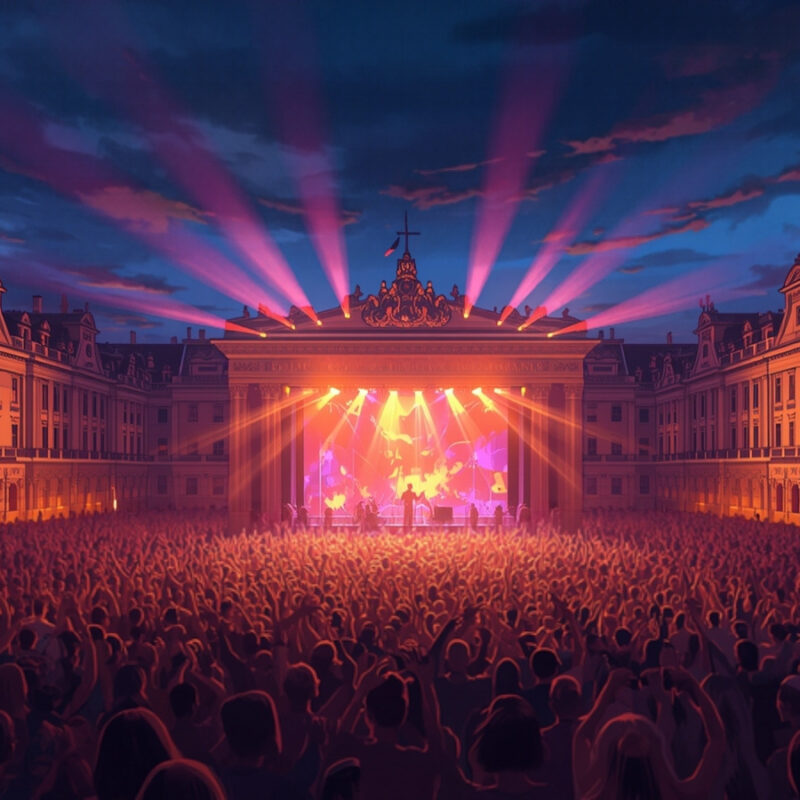
Every summer, the Moroccan capital briefly becomes one of the largest open-air stages on the planet. Festival Mawazine — Rythmes du Monde, running this year from June 19 to 27, has built its reputation on a formula that sounds almost impossible by modern festival economics: free admission, a lineup stretching across dozens of nationalities, and a sprawl of venues scattered through Rabat and neighboring Salé.
This year’s edition, the 21st, spreads performances across familiar sites — the Nahda and OLM Souissi stages, the riverside Bouregreg venue, the historic Chellah grounds — alongside two newly added locations, the Grand Royal Theatre and the Prince Moulay Abdellah Stadium. The expansion reflects how far the festival’s ambitions have grown since its early-2000s launch, when it was conceived largely as a showcase for Moroccan and regional Arab artists alongside international guests.
That founding mission hasn’t disappeared, even as the festival’s international booking has grown more ambitious over the years. Mawazine has always used its global names as a draw while reserving substantial stage time for Moroccan chaabi, Gnawa, and Amazigh musical traditions, along with rising artists from across the Arab world. For many Moroccan performers, a Mawazine slot remains one of the biggest exposure opportunities available domestically, played in front of crowds that dwarf almost any other concert they’ll do that year.
The free-admission model is also, in a quieter way, a statement about cultural access. Morocco’s concert economy, like much of the region’s, is otherwise built around ticketed venues in major cities that cater to audiences with disposable income. Mawazine’s open stages mean a teenager from a working-class Rabat neighborhood can see a global headliner on the same night as a well-off family driving in from Casablanca, standing in the same crowd.
Inevitably, a festival this size draws scrutiny over cost and logistics — crowd management across nine days and multiple venues is no small undertaking, and the festival has faced its share of criticism over security and infrastructure in past editions. But the model has proven durable enough that organizers have kept scaling it up rather than back, and this year’s addition of two new venues suggests confidence that the audience, and the appetite for free, large-scale live music in Morocco, is still growing.
For visitors timing a trip around it, the practical draw is straightforward: nine days, multiple stages, zero ticket cost, and a lineup built to appeal to pretty much anyone who likes live music. For the regional music industry watching from outside Morocco, the more interesting story is what Mawazine proves about appetite — that a festival built on free access, rather than premium ticketing, can still anchor itself as one of the most significant dates on the region’s cultural calendar.
Read more
 Faia Younan returns with acoustic love song Kad Takoun and a storybook videoNovember 20, 2026
 Five Arabic Releases Worth Your Time So Far This YearOctober 4, 2026
 One Sound, Many Borders: The Quiet Fusion Reshaping Arabic Dance MusicOctober 4, 2026
 Among the Roman Columns: Why Baalbeck’s Summer Festival Still Draws Lebanon’s Biggest StagesOctober 4, 2026